Launch offer — valid today only

📄 Digital book in PDF · read it on your phone or print it

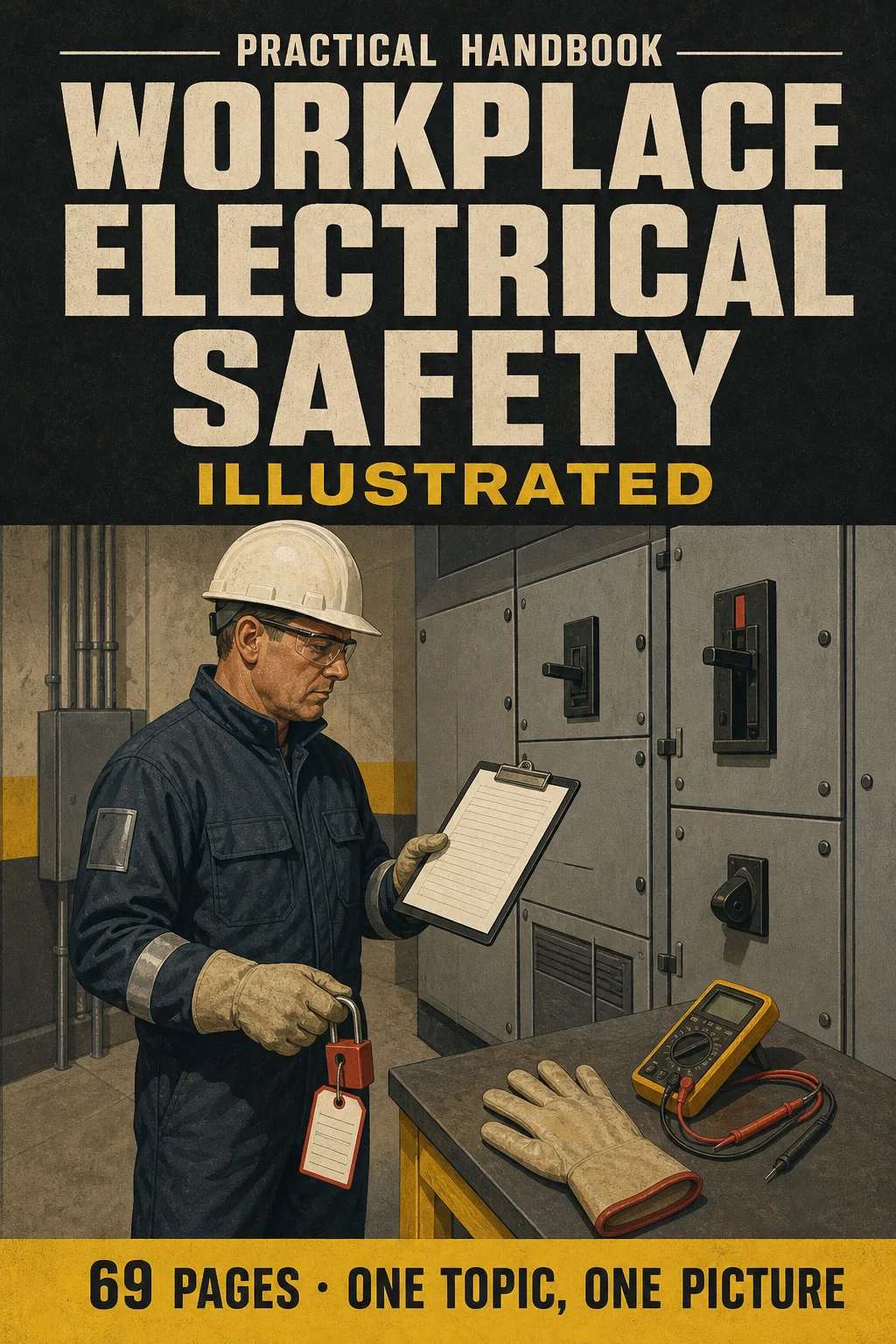
Workplace Electrical Safety in Drawings Every Answer on Its Own Page

For NFPA 70E work and the CESCP and CESW exams: shock and arc flash boundaries, lockout and live-dead-live, stored energy, the energized work permit, arc flash labels, rubber glove classes and PPE head to toe. Each topic has its own page: the drawing first, then what you need to remember. 69 illustrated pages.

GET THE ILLUSTRATED BOOK

🔒 Secure checkout · PDF by email · 30-day guarantee

Every topic, its own pageEach boundary, step and label drawn, with the explanation right next to it
69 illustrated pages9 parts, from the map of the standard to the numbers to have at hand
Up-to-date sourcesNFPA 70E (2024 edition), OSHA 1910 Subpart S and 1910.147
PDF by emailFormat

Look Inside the Book

Every page has one big drawing and a box with the distances, steps and numbers you need to know:

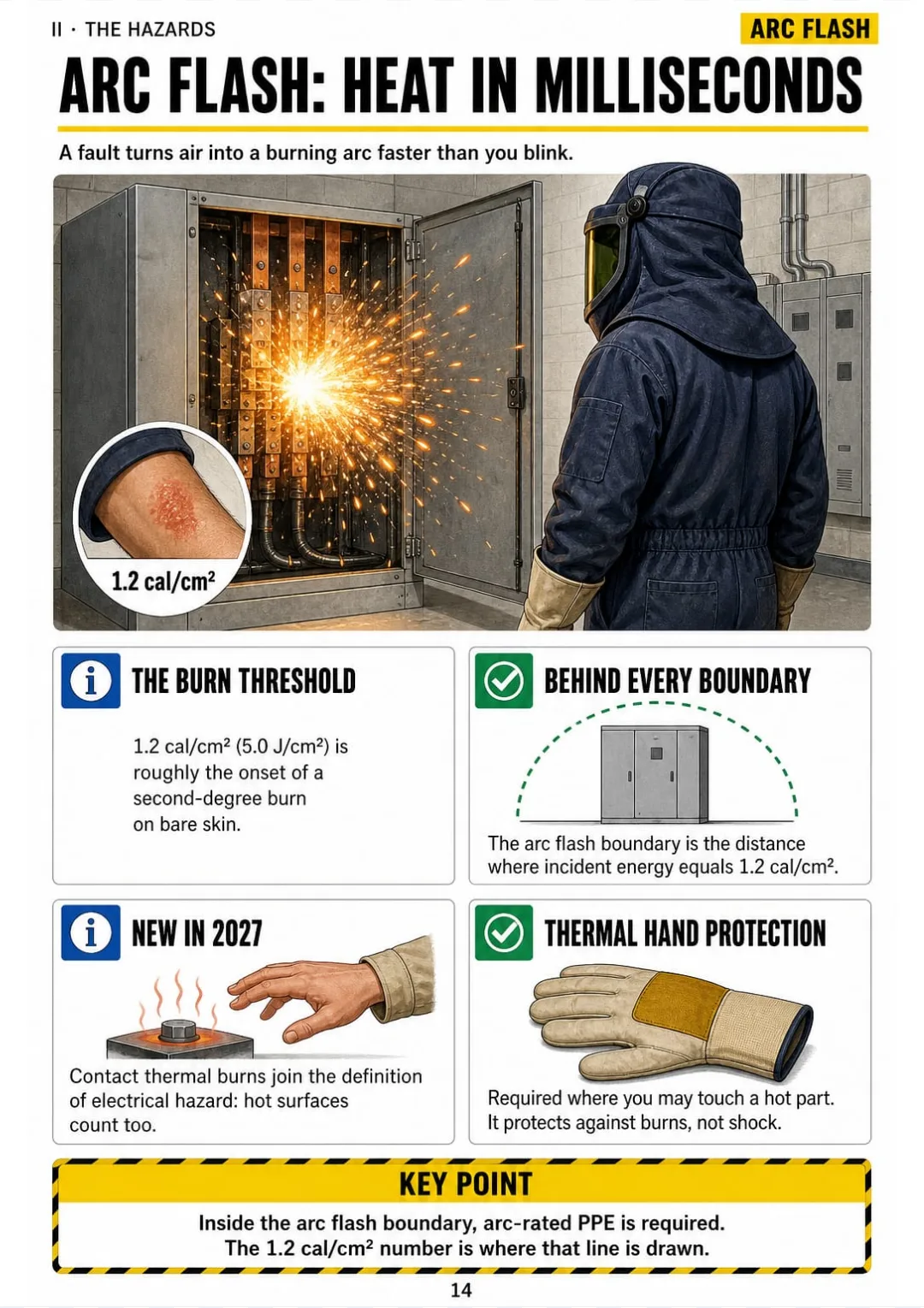
Arc flash: 1.2 cal/cm² is the onset of a second-degree burn and sets the arc flash boundary.
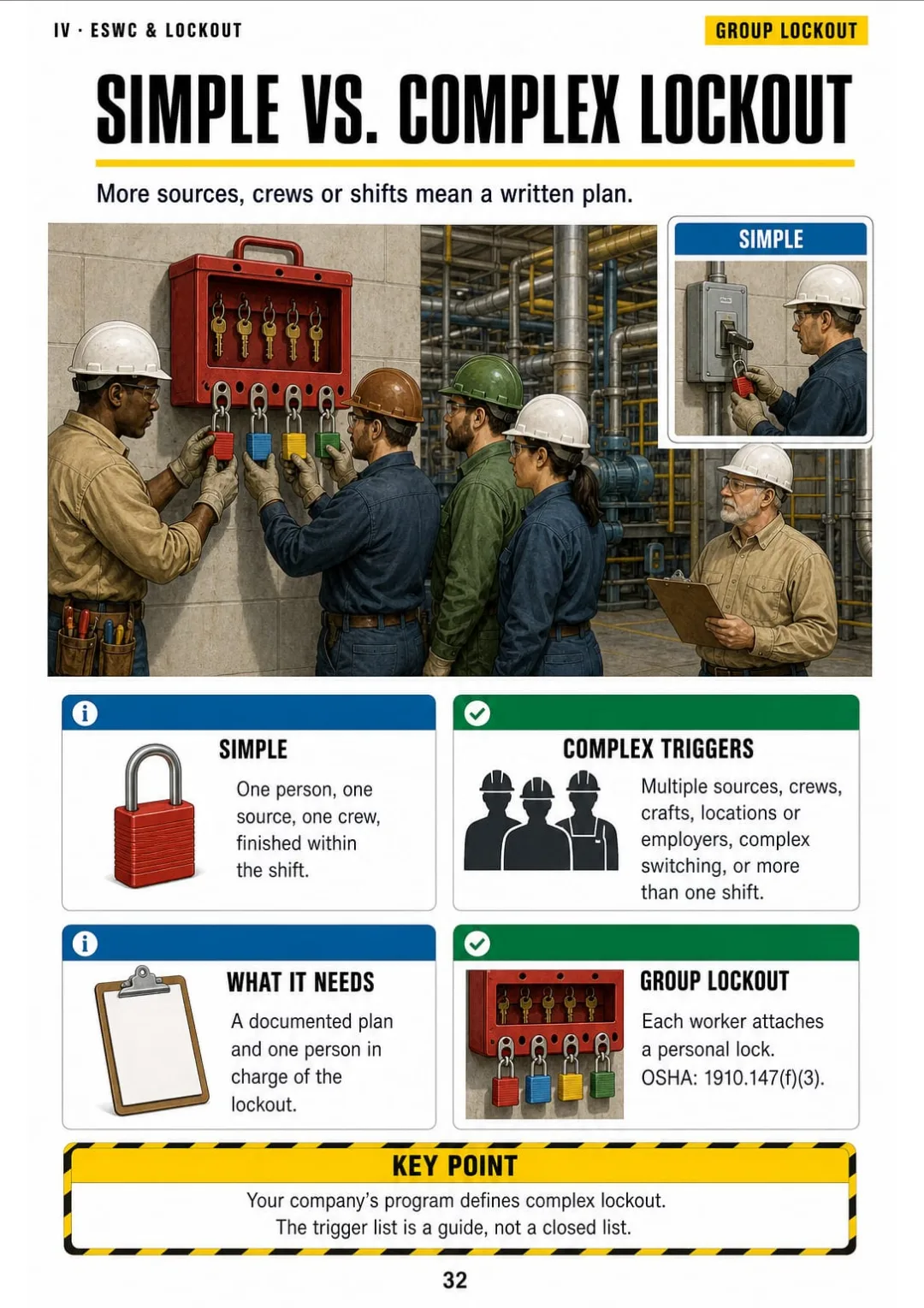
Complex lockout: written plan, person in charge, and a personal lock for each worker.
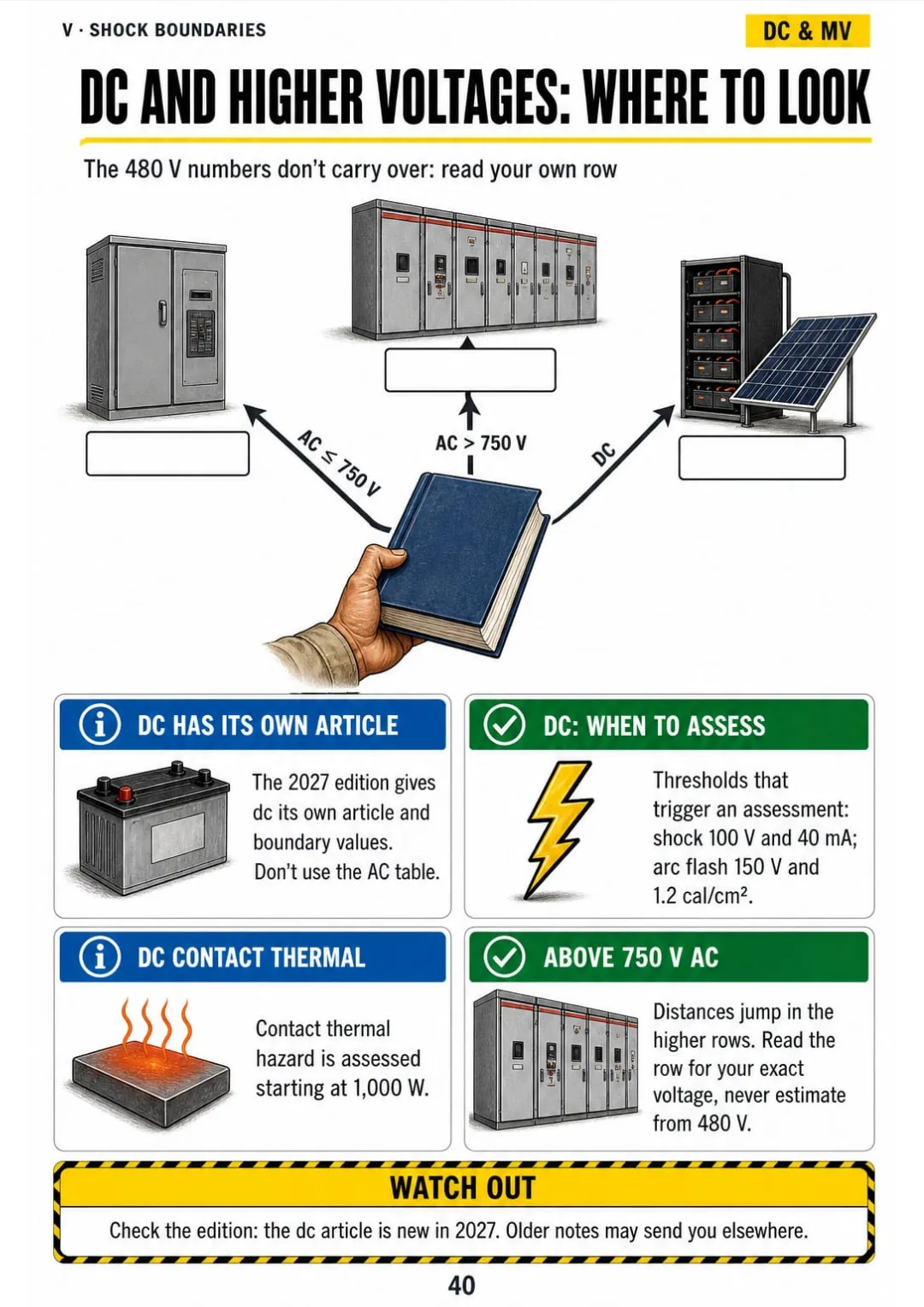
DC: Article 310 (2027), shock assessed from 100 V and 40 mA; above 750 V AC, read your row.
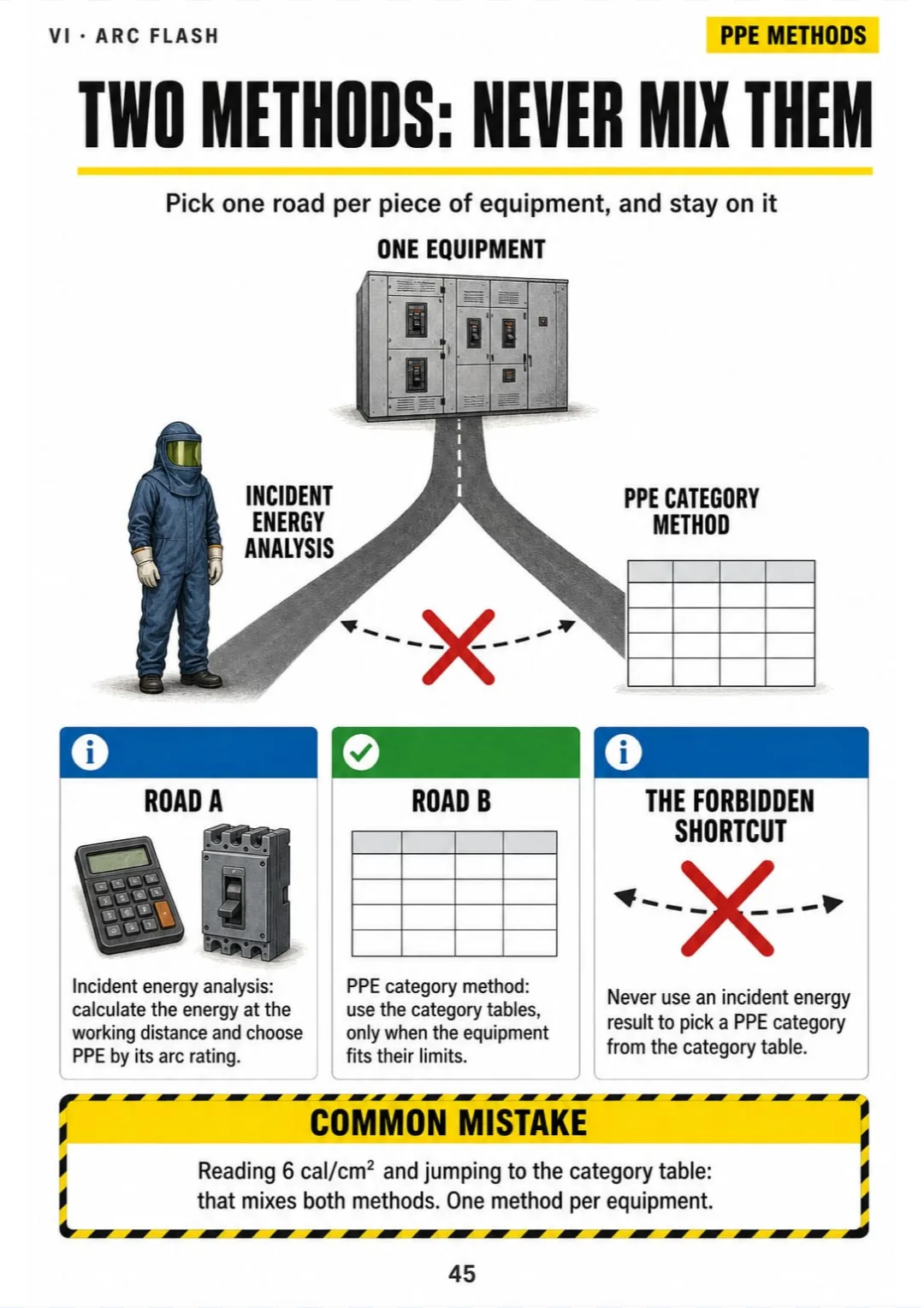
Incident energy analysis OR PPE category method — never both on the same equipment
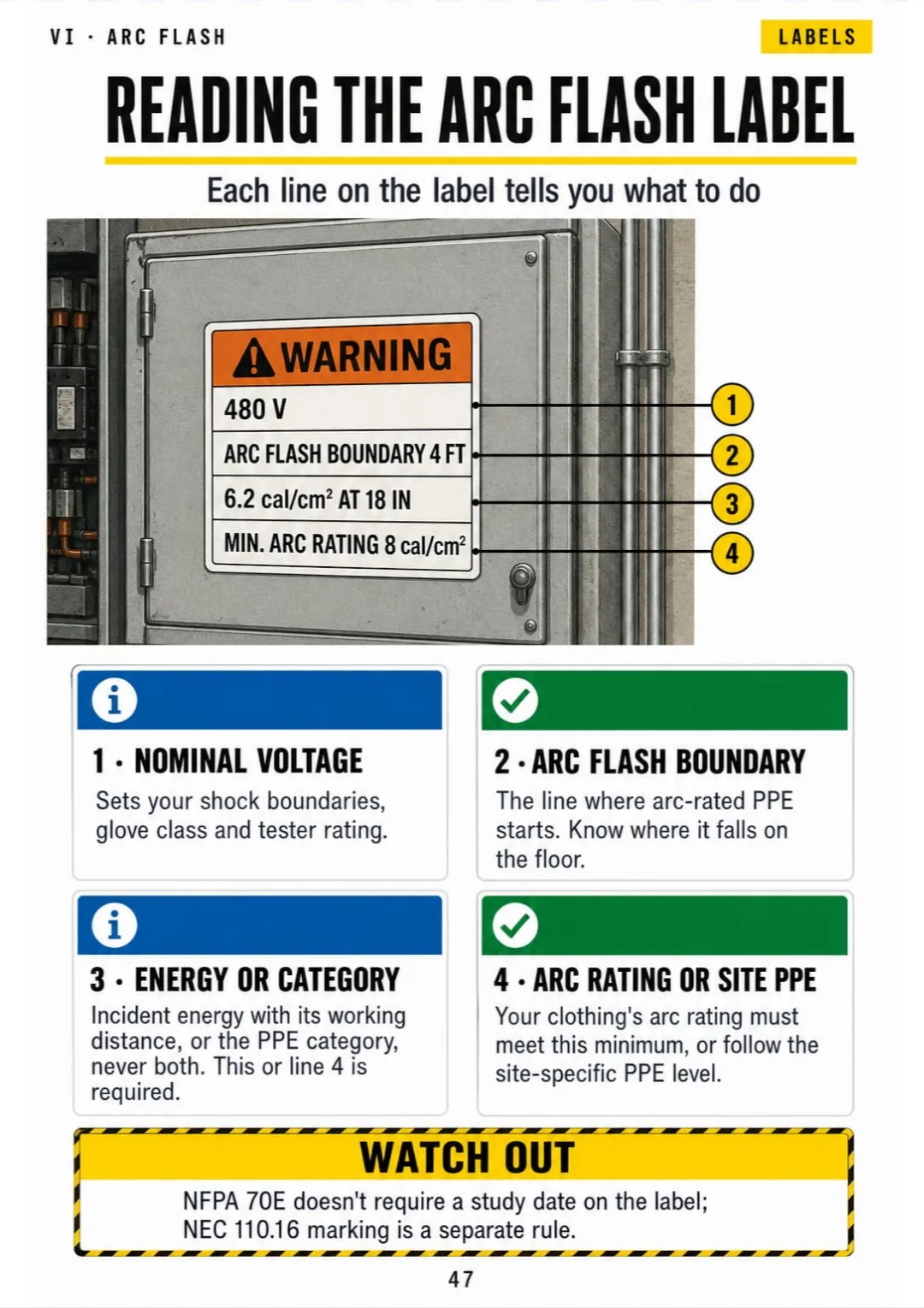
Example label: 480 V, boundary, energy at distance or category, minimum arc rating
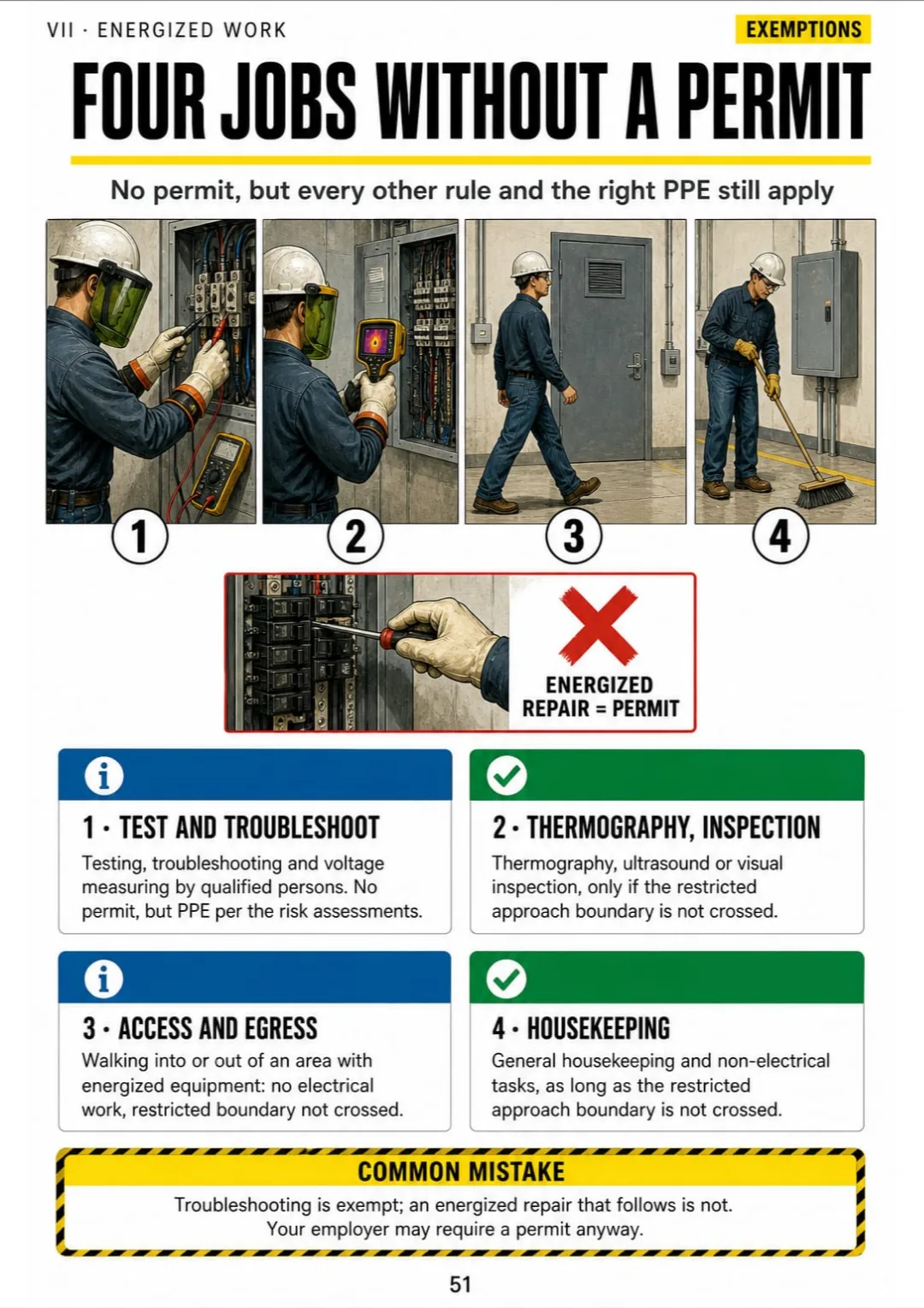
Exempt: testing, thermography outside the restricted ring, access, housekeeping (130.3(C), 2027).
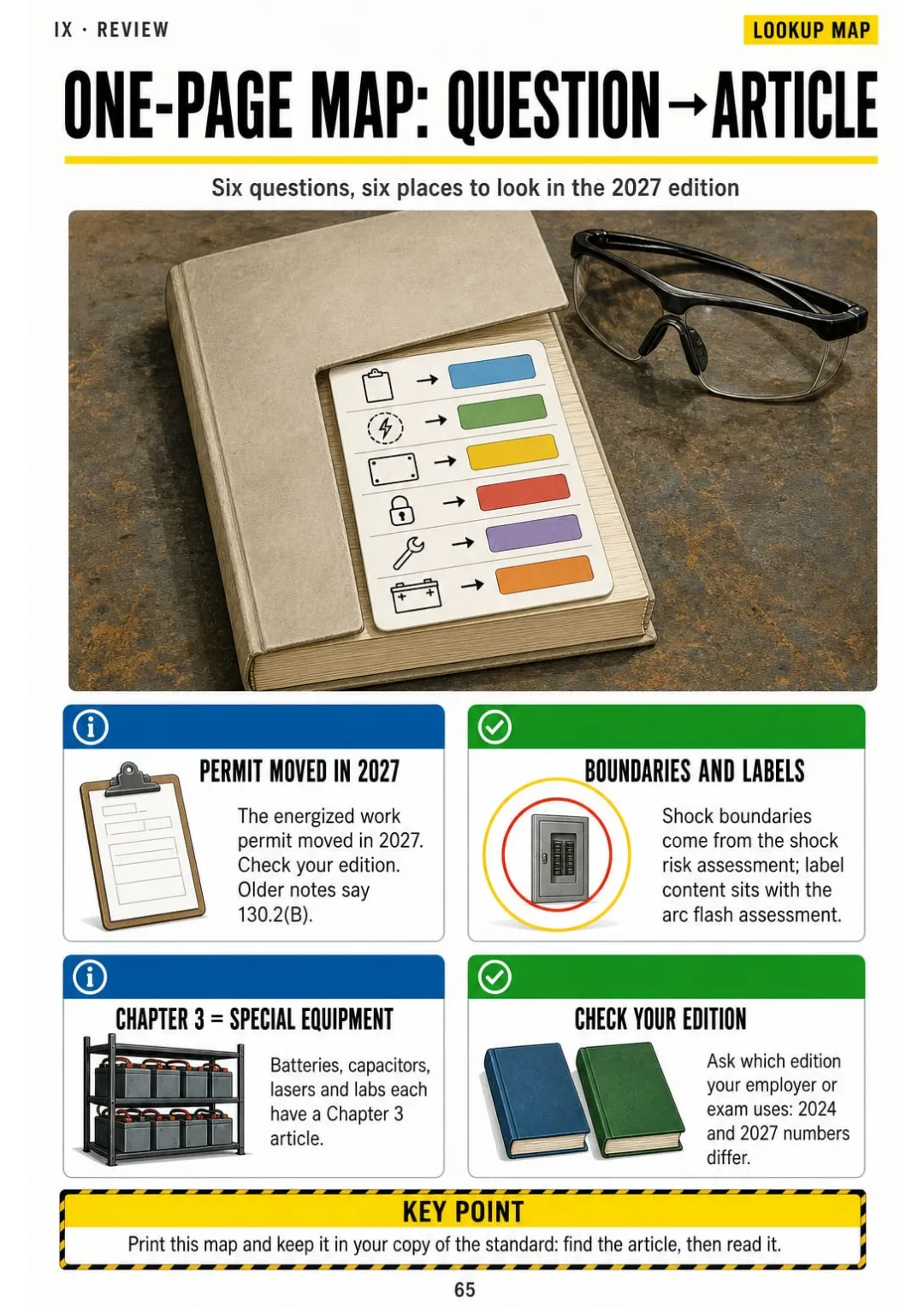
Permit → 130.3 · Lockout → Art. 120 · Batteries → Art. 360 (2027 edition)
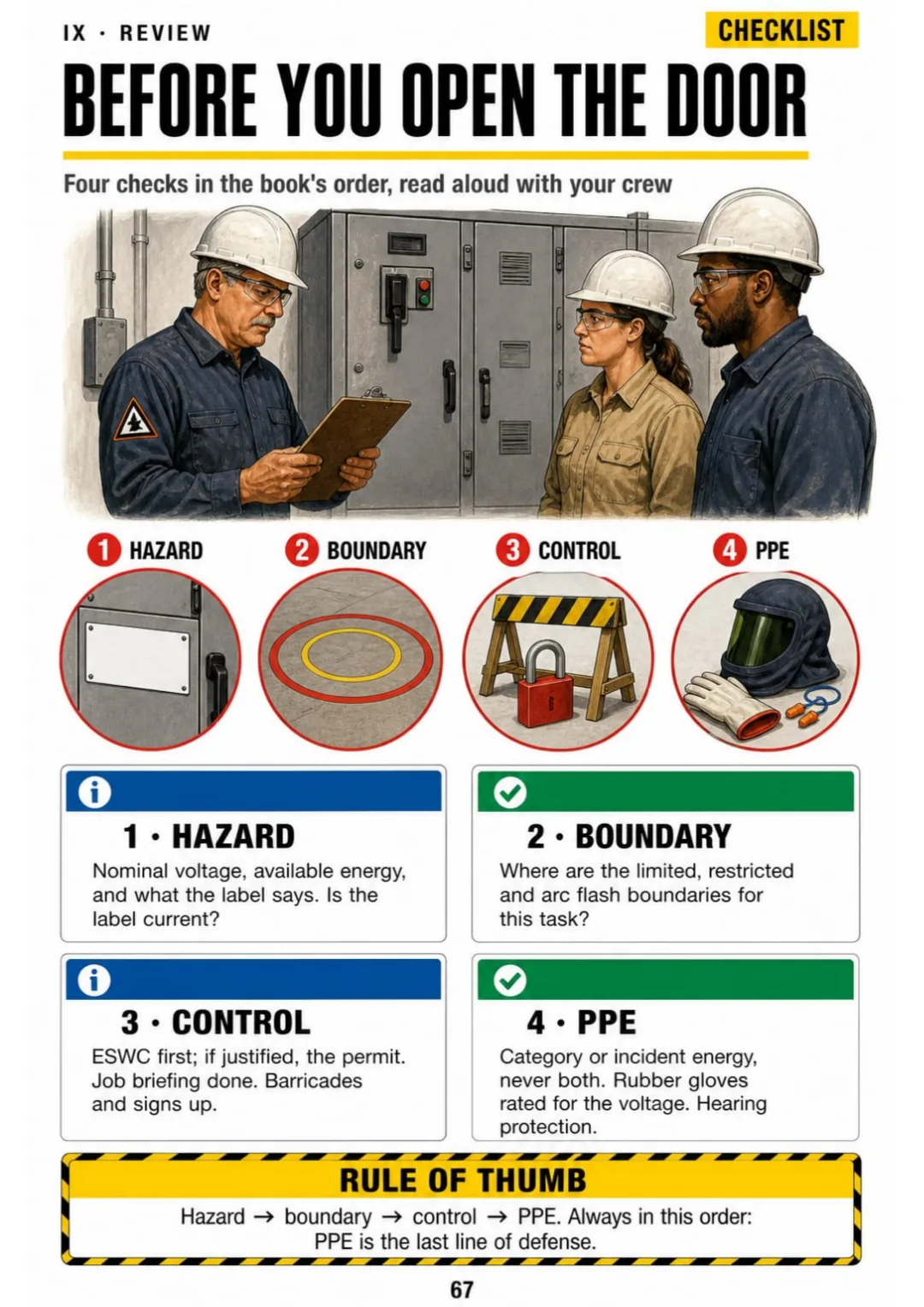
Hazard → Boundary → Control → PPE: the pocket checklist to read with your crew

Swipe to see more →

These are real pages from the book. The table of contents is the full one: 9 parts and 65 topics.

The Problem Isn't You. It's How It Was Explained to You.

You're standing at an open 480-volt panel and a tech asks how close he can get. You know the answer is in the standard. You just don't know where.

The boundaries come as paragraphs, footnotes and a table split into columns. Fixed parts, movable conductors, limited, restricted: four ideas packed into rows you read tonight and lose by morning.

DC: Article 310 (2027), shock assessed from 100 V and 40 mA; above 750 V AC, read your row.

In the book, that same panel is a drawing. Two rings around it: limited at 3 ft 6 in for fixed parts or 10 ft for a movable conductor, restricted at 1 ft. Who may cross each ring is written right there.

Same with live-dead-live, the energized work permit, the arc flash label and rubber glove classes: each one has its own page.

You look at the rings, you answer the tech, and you set the boundary without reopening the manual.

COMPARE FOR YOURSELF

The Same Topic, Two Ways to Study It

THIS
  • The manual: line after line after line
  • Lockout steps explained only in words
  • You reread it and still mix up the order
Prior to the commencement of any task on equipment removed from service, the worker is expected to have identified every source capable of supplying energy to it, to have confirmed that the load was interrupted before any disconnect was operated, to have confirmed by sight, wherever conditions allow, that the disconnect is in the open position, to have dealt with any energy still held in capacitors, springs or similar components, to have applied the locks and tags required under the employer's program, to have confirmed with a suitable meter that no voltage remains, and to have considered temporary grounding wherever conditions call for it.
FOR THIS
  • The safe work condition drawn as one sequence
  • The steps numbered in a box
  • Live-dead-live drawn: meter on a known source, the circuit, the known source again
Complex lockout: written plan, person in charge, and a personal lock for each worker.
CONTENTS

Take a Look at the 9 Parts and 65 Topics

The map of the standard, the hazards, the program and the people, lockout and the safe work condition, shock boundaries, arc flash and labels, energized work, PPE head to toe and a final review: 69 pages, all illustrated

IThe Map: How the Standard Is Built · pp. 5-11
  1. Who Writes the Rule and Who Enforces It
  2. The Standard on One Page
  3. Article 130: Where Most Answers Live
  4. Annexes: Informative, Not Mandatory
  5. Finding Any Answer in 3 Moves
  6. The Words That Change the Answer
  7. The Order of This Book: Hazard → Boundary → Control → PPE
IIThe Hazards: Shock, Arc Flash, Arc Blast · pp. 12-17
  1. Shock: What Current Does to the Body
  2. The Current Path and Why Hand-to-Hand Is Worst
  3. Arc Flash: Heat in Milliseconds
  4. Arc Blast: Pressure, Sound and Shrapnel
  5. What Starts an Arc Flash
  6. Under 50 Volts: When the Rules Relax and When They Don't
IIIThe Program and the People · pp. 18-24
  1. The Electrical Safety Program in 6 Pieces
  2. The Hierarchy of Risk Control
  3. Qualified vs. Unqualified Person
  4. Training Records and the 3-Year Rule
  5. Emergency Response: Release, CPR, AED
  6. Audits: Program, Field Work and Lockout
  7. Host Employer and Contract Employer
IVElectrically Safe Work Condition and Lockout · pp. 25-34
  1. De-Energize First: When Energized Work Is Allowed
  2. Establishing an ESWC: The Steps in Order
  3. Until Proven Safe, It's Energized
  4. Live-Dead-Live: Testing for Absence of Voltage
  5. Absence of Voltage Testers
  6. Stored Energy: Capacitors, Springs and Batteries
  7. Lock, Tag, and When a Tag Alone Is Allowed
  8. Simple vs. Complex Lockout
  9. Shift Change and Removing Someone Else's Lock
  10. Returning Equipment to Service
VShock Risk and Approach Boundaries · pp. 35-41
  1. The Shock Risk Assessment in 3 Questions
  2. Limited and Restricted: The Two Rings
  3. Reading the Boundary at 480 Volts
  4. Fixed Parts vs. Movable Conductors
  5. Who May Cross Each Ring
  6. DC and Higher Voltages: Where to Look
  7. Overhead Lines and the 10-Foot Rule
VIArc Flash Risk Assessment and Labels · pp. 42-49
  1. The Arc Flash Risk Assessment: Likelihood and Severity
  2. The Arc Flash Boundary Is 1.2 cal/cm²
  3. Incident Energy and Working Distance
  4. Two Methods: Never Mix Them
  5. The PPE Category Method: When You May Use It
  6. Reading the Arc Flash Label Line by Line
  7. Keeping Labels True: Changes and the 5-Year Review
  8. Maintenance Changes the Arc Flash
VIIEnergized Work: Permit, Briefing and Tools · pp. 50-56
  1. When an Energized Work Permit Is Required
  2. The Permit Exemptions
  3. What Goes on the Permit
  4. The Job Briefing: What to Cover Before You Start
  5. Alerting Techniques: Signs, Barricades, Attendants
  6. Insulated Tools and Test Instruments
  7. Portable Equipment, Cords and GFCI
VIIIPPE From Head to Toe · pp. 57-64
  1. Arc-Rated vs. Flame-Resistant
  2. The Four PPE Categories
  3. Head and Face: Hard Hat, Shield, Balaclava, Hood
  4. Hearing Protection Is Required
  5. Rubber Insulating Gloves: Classes and Voltages
  6. Glove Inspection and the 6-Month Retest
  7. Hands, Body and Feet in the Arc Flash Zone
  8. Care, Fit and the Outer Layer Rule
IXReview: Quick Checks and Frequent Mistakes · pp. 65-69
  1. One-Page Map: Question → Article
  2. The Numbers to Have at Hand
  3. Before You Open the Door: The Task Checklist
  4. Frequent Mistakes on the Job
  5. Frequent Mistakes on the Exam

One Page, One Topic, All Clear

Think of it this way:

It's exam day, open book, and the question asks when an energized work permit is not required. The clock is running while you flip through the standard.

In the book you already know that page: four jobs drawn side by side, testing, thermography outside the restricted ring, access and housekeeping, with the part of the standard where the rule lives.

Example label: 480 V, boundary, energy at distance or category, minimum arc rating

Same with the safe work condition steps, the 480-volt boundaries, the arc flash label and the glove retest: each one on its own page.

Workplace Electrical Safety Illustrated is 9 parts and 65 topics, all drawn, and it closes with a one-page question-to-article map, the numbers to have at hand and the most frequent mistakes on the job and on the exam.

What you see drawn, you don't have to memorize.

What's Inside Workplace Electrical Safety Illustrated:

Ipp. 5-11

The Map: How the Standard Is Built

Who writes the rule and who enforces it, the standard on one page, Article 130, the annexes and how to find any answer in 3 moves.

IIpp. 12-17

The Hazards: Shock, Arc Flash, Arc Blast

What current does to the body, the current path, arc flash heat, arc blast, what starts an arc and what changes under 50 volts.

IIIpp. 18-24

The Program and the People

The electrical safety program, the hierarchy of risk control, qualified vs. unqualified, training records, emergency response, audits and host vs. contract employer.

IVpp. 25-34

Electrically Safe Work Condition and Lockout

When energized work is allowed, the safe work condition steps in order, live-dead-live, stored energy, locks and tags, complex lockout, shift change and return to service.

Vpp. 35-41

Shock Risk and Approach Boundaries

The shock risk assessment, the limited and restricted rings, the 480-volt example, fixed vs. movable, who crosses each ring, DC and overhead lines.

VIpp. 42-49

Arc Flash Risk Assessment and Labels

Likelihood and severity, the 1.2 cal/cm² boundary, incident energy, the two methods, the PPE category method, the label line by line and the 5-year review.

VIIpp. 50-56

Energized Work: Permit, Briefing and Tools

When the permit is required, the exemptions, what goes on it, the job briefing, barricades and attendants, insulated tools, cords and GFCI.

VIIIpp. 57-64

PPE From Head to Toe

Arc-rated vs. flame-resistant, the four PPE categories, head and face, hearing, rubber glove classes, the 6-month retest and the outer layer rule.

IXpp. 65-69

Review: Quick Checks and Frequent Mistakes

The question-to-article map, the numbers to have at hand, the task checklist and the frequent mistakes on the job and on the exam.

At the end of the book: A one-page question-to-article map, the numbers to have at hand and the frequent mistakes on the job and on the exam.
Plus: 2 Free Books

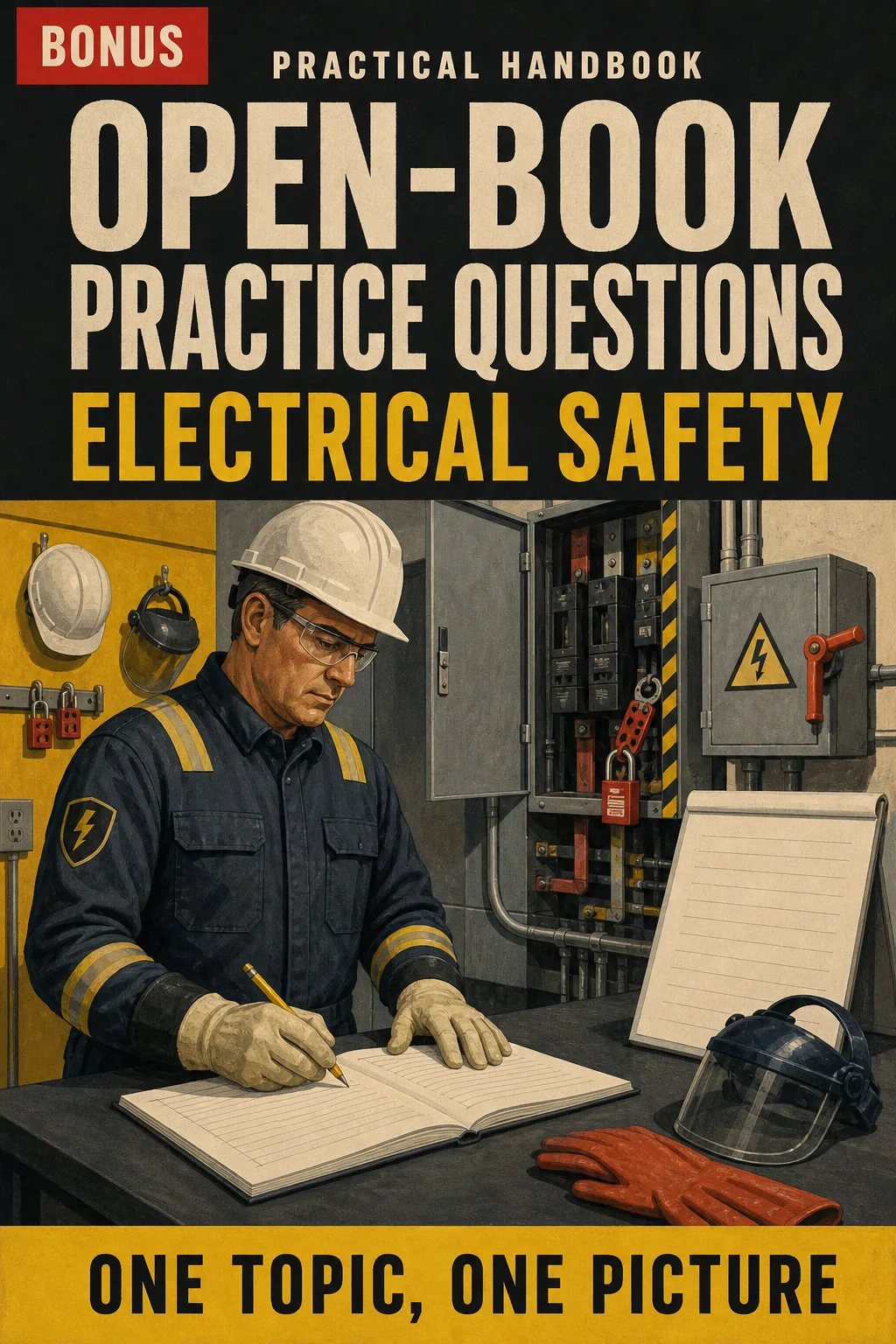
Open-Book Practice Questions: Electrical Safety

BONUS 1: «Open-Book Practice Questions: Electrical Safety»

Value on its own: US$ 17.90

Practice finding answers in the standard under time pressure, with exam-style questions and an explained answer for each one.

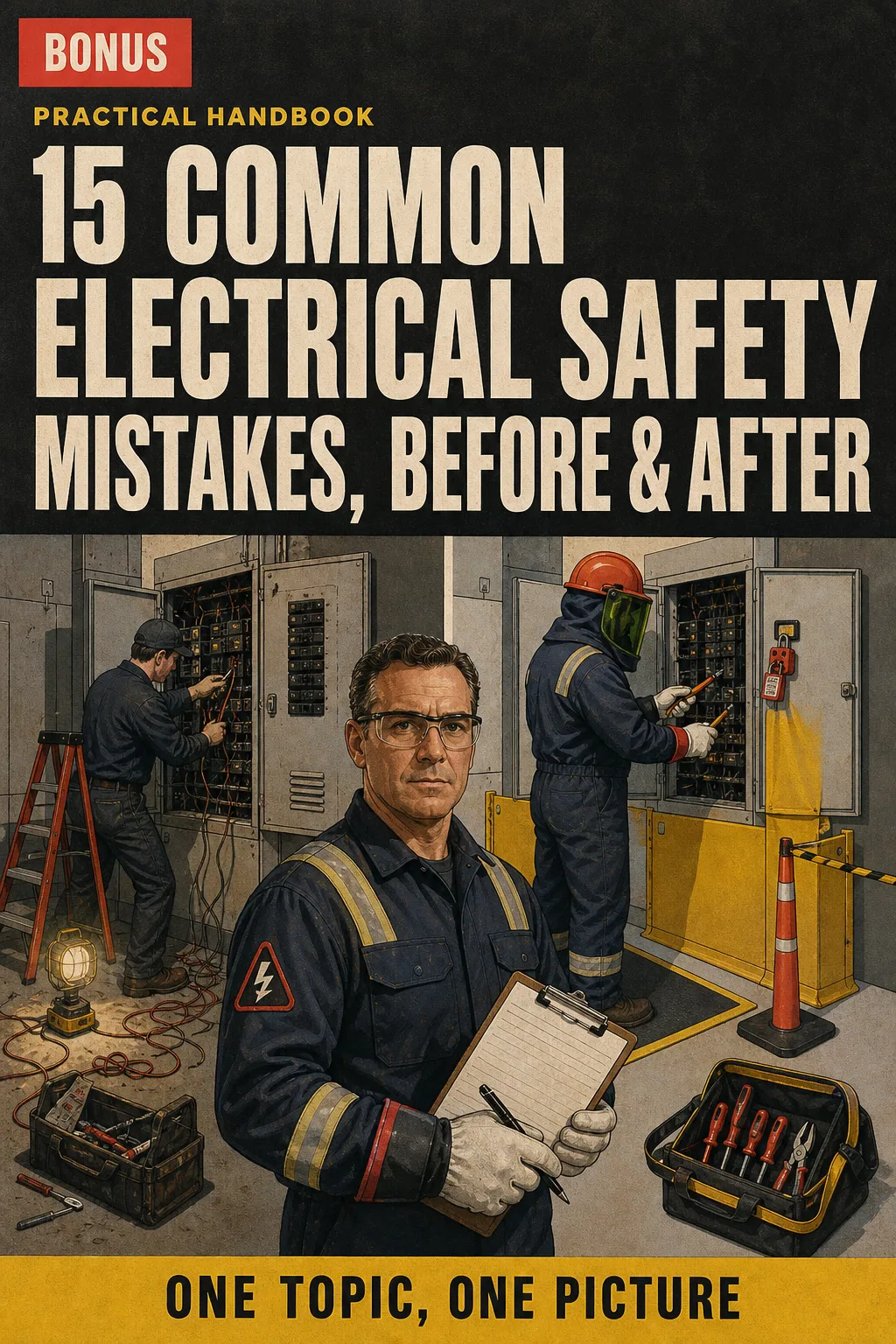
15 Common Electrical Safety Mistakes, Before & After

BONUS 2: «15 Common Electrical Safety Mistakes, Before & After»

Value on its own: US$ 14.90

See the most frequent mistakes on the job and on the exam drawn side by side with the right way, so you catch them before they happen.

Workplace Electrical Safety Illustrated with 2 Free Books

  • Workplace Electrical Safety Illustrated: 69 illustrated pagesUS$ 63
  • BONUS 1: Open-Book Practice Questions: Electrical SafetyUS$ 17.90
  • BONUS 2: 15 Common Electrical Safety Mistakes, Before & AfterUS$ 14.90
  • High-resolution PDF to printIncluded
Total value US$ 95.80
YOUR PRICE:
US$ 27
You save US$ 68.80
YES, I WANT WORKPLACE ELECTRICAL SAFETY ILLUSTRATED FOR US$ 27

📄 This is a digital PDF book sent to your email: nothing is printed or shipped.

Secure purchaseEncrypted payment30-day guarantee

PDF by email: We email you Workplace Electrical Safety Illustrated as a PDF, together with the two free books. It's a single payment: no installments, no extra charges.

Who This Book Is For

You're studying for the CESW

You're studying for the CESW

Each topic of the standard on its own page, always in the same order: hazard, boundary, control, PPE. You get the logic before you memorize a single number.

Your CESCP exam is coming up

Your CESCP exam is coming up

A map from question to article and the key numbers on one page, so in an open-book exam you know where to look before the clock runs out.

You already run a crew

You already run a crew

Pages you can print and show at a job briefing: the rings, the lockout steps, the label. You explain it to your crew, or to the auditor, without hesitating.

Everything You Get Today

US$ 95.80US$ 27
YES, I WANT WORKPLACE ELECTRICAL SAFETY ILLUSTRATED FOR US$ 27

📄 This is a digital PDF book sent to your email: nothing is printed or shipped.

30DAYS
GUARANTEE

30-Day Guarantee

Try Workplace Electrical Safety Illustrated for 30 days, bonus books included.

We refund everything if the file won't open, if the book isn't what you see here, if you were charged twice or if the email doesn't arrive. Just email us.

You pay once. No subscriptions.

Frequently Asked Questions

Is it for me if I've been in the trade for years?

Yes. It doesn't teach you the job. It works next to your copy of the standard: each topic drawn on one page, with the part of the 70E where the rule lives. The standard has the full text; this book shows you where to look and what it means, for the exam, an audit or a crew briefing.

Where does the content come from?

From NFPA 70E, 2024 edition, plus OSHA 29 CFR 1910 Subpart S, 1910.147 for lockout and 1926 Subpart K for construction. Each page points to the part of the standard where the requirement lives, without reproducing its text or tables. Section numbers change between editions, so check which edition your exam is based on.

Is this official material?

No. It's independent study material. It isn't affiliated with, endorsed by or approved by NFPA, OSHA or any certification body.

Does it replace my training?

No. It doesn't replace your employer's training, your qualified-person designation or your electrical safety program, and it doesn't come with a certificate or continuing education credits. It's for studying and reviewing.

Are the practice questions the ones on the exam?

No. They're written for this book, in the style of an open-book exam, so you practice finding answers in the standard. They are not official CESCP or CESW questions. On exam day, use only the references the certification body allows (check its current candidate rules): this book is for preparing before, so you know where to look in your copy of the 70E.

When and how do I get it?

The book and the 2 bonus books come as PDFs by email, to the address you enter at checkout.

Do I have to pay every month?

No. It's a one-time payment.

Can I have it on paper?

Yes. It's a PDF you can print at home or at a print shop and take to the job.

How does the refund work?

You have 30 days. We refund everything if the file won't open, if the book isn't what you see on this page, if you were charged twice or if the email doesn't arrive: just email us.

Before You Close This Page

No more rereading without it sticking.

The 480-volt boundaries: you see them drawn, and that's it.

You walk into the exam knowing where each answer lives.

Drawings make studying faster.

The book is right below.

One-time payment: US$ 27 · Guarantee: 30 days · PDF by email

YES, I WANT WORKPLACE ELECTRICAL SAFETY ILLUSTRATED FOR US$ 27

📄 This is a digital PDF book sent to your email: nothing is printed or shipped.